
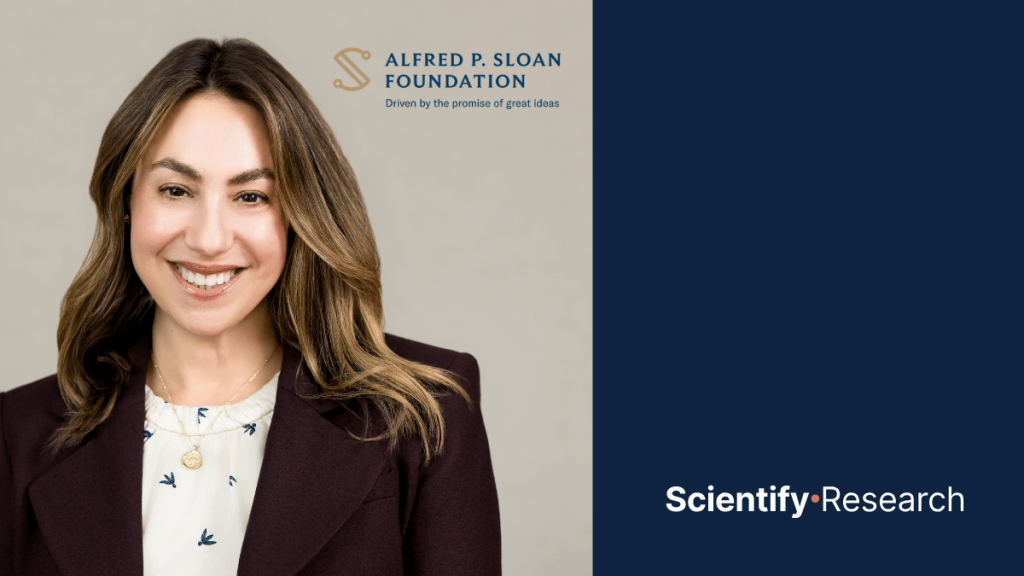
Preface: In this interview we speak with Dr. Stacie Bloom, President and CEO of the Alfred P. Sloan Foundation. Here she discusses the Foundation’s mission in funding research in science, technology, engineering, math, and economics, as well as information about the Sloan Research Fellowships.
Sloan Foundation’s mission and priorities
Tell us about the founding and primary goals of the Alfred P. Sloan Foundation.
Alfred Sloan was the leader who turned General Motors into one of the largest companies in the world. He had a front row seat to the creation of the American middle class and saw how scientific innovation and individual creativity could raise living standards and build a more prosperous world. That was our founding insight in 1934, and nearly a hundred years later, we still hold this philosophy as core to our mission. We work to empower extraordinary researchers to unleash transformative discovery and innovation.
What is your role and area of focus within the Alfred P. Sloan Foundation?
As President and CEO of the Sloan Foundation, I see my role as stewarding the legacy of the Sloan Foundation as a funder of original research and scientific advancement, and connecting that legacy to a strategic vision that rises to the challenges of today and tomorrow. I strive not only to build on Sloan’s long history of excellence, but also to identify the areas where our resources can have the greatest impact.
How does the Foundation translate its mission of advancing scientific knowledge to improve human welfare into specific grant-making priorities?
Our grantmaking is informed by where we can make the most impact.
About half of our grantmaking supports new research across focus areas that include economics, energy and the environment, synthetic biology, and small-scale fundamental physics. Many of these areas are underfunded by other sources, and even among the more established fields, we look to support new approaches that cast long-standing challenges in a new light.
Beyond supporting new knowledge, we also want to make sure that a diverse audience has access to and appreciation for that knowledge. The other half of our grantmaking is split between initiatives that expand access to graduate STEM programs, develop or leverage technologies to support research infrastructure, and deepen public engagement with topics in science and technology.
How does Sloan define and measure a project’s “expected return to society,” particularly when funding fundamental research whose benefits may take years to appear?
One of the most valuable roles that private foundations play in the science ecosystem is that we can take a long-term perspective in ways that government or for-profit companies can’t. We can commit to funding areas where opportunities for impact are large, but change is gradual and incremental. For example, Sloan has been partnering with educators to help increase access and fair opportunity in STEM higher education for the better part of three decades.
In more specific terms, all Sloan grants come with a series of goals and metrics that we jointly work out with our grantees that represent a shared understanding of what success looks like. These will differ project by project—research grants may be measured in papers published, grants to build software might be measured by usage, grants for science-themed media might be measured by reach—but they provide an essential framework for understanding what success means. But it’s only a framework. Science is open-ended and full of surprises and some of its most important benefits can’t be predicted. Evaluating a grant’s success is an ongoing conversation with our grantees, one that is flexible and adaptive to each situation.
Advice for Sloan Research Fellowship applicants
The Sloan Research Fellowships provide early-career researchers with two-year, $75,000 awards that can be used flexibly to support their research. What advice do you have for applicants?
Apply! Over the past 70 years, the Sloan Research Fellowships have become one of the most sought after awards available to young scientists. We know there is innovative science happening everywhere, and the Sloan Fellows are drawn from a very diverse group of institutions. Almost every year, there’s at least one Fellow from an institution that has never won a Fellowship before. So, don’t assume that the Sloan Research Fellowships are beyond your reach. If you’re doing exciting science, we want to hear from you.
Sloan looks for original, methodologically rigorous projects with a high expected return to society. How are those qualities evaluated during the proposal-review process?
In many ways, the process is analogous to the peer-review process at scientific journals, because we want to ensure that we fund credible and rigorous projects that meaningfully contribute to driving forward the research frontier.
Proposals are evaluated both internally at the Foundation by our program staff and externally by a panel of expert reviewers. Often, these reviewers are senior scientists or practitioners at the forefront of the relevant discipline. They evaluate and provide feedback on the proposed projects, and then the proposers get a chance to respond, often by adapting or modifying their projects to address the concerns. The process is highly participatory and iterative. We get regular feedback from grantees telling us that the Sloan grant approval process helped them think through their work and make it stronger.
Beyond research accomplishments, what evidence of creativity, independence, and leadership potential distinguishes a successful Sloan Research Fellowship nominee?
One of the features of the Sloan Research Fellows that has made them so influential is that they are actually awarded by the scientific community. All candidates must be nominated by a senior scientist, and then each candidate is evaluated by one of seven expert Selection Committees. That allows each discipline to apply its own internal standards of research excellence, of what constitutes creativity, and how to evaluate leadership potential. And the results speak for themselves. Some 60 former Sloan Research Fellows have gone on to win the Nobel Prize and hundreds of others have won other notable awards, prizes, and honors.
Beyond individual grants: systemic change in STEM
The Sloan Centers for Systemic Change focus on addressing barriers within STEM doctoral programs at the departmental and institutional levels. Tell us more about these centers, and how is this model different from programs that primarily fund individual scholarships or student services?
Providing individual scholarships to graduate students is extremely important and Sloan supports hundreds of STEM graduate students across the country with flexible graduate stipends of about $40,000. This funding is often critical for helping students navigate their graduate studies. But student stipends alone are not enough. That’s where the Sloan Centers for Systemic Change are really exciting. These are partnerships with select colleges and universities who are bringing a large, systemic change focus to helping STEM graduate students succeed. That means we’re not only focusing on helping students get through graduate school but also working with educators to apply evidence-based insights to improve the policies and practices of STEM graduate programs so they are systemically more effective for all students. That involves looking at what the best evidence tells us about how to reform the practices of recruitment, admission, pedagogy, and evaluation in STEM graduate education to set students up for success.
How does the Sloan Indigenous Graduate Partnership incorporate Indigenous knowledge, community priorities, and student experiences into the design of STEM graduate education?
Very few Indigenous students receive advanced degrees in STEM. That’s due, in part, to the fact that graduate programs weren’t designed with the needs of Indigenous students in mind. Demographically, Indigenous students tend to be older than non-Indigenous students, more likely to be married, and more likely to have children. Many graduate programs tend to be inflexible in ways that make them difficult to pursue while continuing to participate in tribal life. Further, Indigenous graduate students often want to bring their new scientific training back to their tribal communities to address issues facing the tribe. But few graduate programs are oriented towards helping them do that. Taken together, these are considerable obstacles. But they don’t have to be. That’s what the Sloan Indigenous Graduate Partnership does. It’s another systemic change initiative that partners with campuses to create graduate programs that are responsive to student needs.
What’s next for science funding
Looking ahead, which scientific, economic, or higher-education challenges are most likely to shape the forthcoming years of the Foundation’s next major grants and initiatives?
Today’s world is much different from the one in 1934 when the Foundation was founded. It’s more global, more interconnected, and more polarized than ever before. As a Foundation, we are looking to support work to meet these new challenges head-on. One clear focus over the next decade will be helping scientific institutions scale the interdisciplinary research that’s essential to addressing our globally connected systems.
We also want to explore how new technologies like artificial intelligence are shaping and reshaping scientific research, higher education, and collaboration, so that they can be used constructively and thoughtfully to advance scientific understanding. We are always on the lookout for high-risk, high-reward projects that transform the way science is carried out and shared.
Acknowledgments
We would like to extend our gratitude to Dr. Stacie Bloom for taking the time to share her perspectives on the Alfred P. Sloan Foundation‘s mission and impact. We very much appreciate the Foundation’s support for leadership in technology and engineering, as well as its commitment to strengthening a diverse scientific workforce.