



Estimated reading time: 8 minutes
Preface: This essay by Dr. Stephanie Juané Kennedy at the University of the Free State and the National Health Laboratory Services Universitas Academic Laboratory is one of ScientifyResearch’s Rare Disease Science Communication Award entries.
I started training as a haematology resident during the first wave of the COVID-19 pandemic in 2020 in South Africa. On my first day in the bleeding disorder clinic, I curiously observed that nearly all the files had the same surname. I realised that the patients were all from about five families who had a rare autosomal dominant disease called hereditary haemorrhagic telangiectasia (HHT). During the COVID-19 pandemic, I gained insights into the unique challenges that patients with HHT faced. For them, it was not always as simple as “wearing a facemask”, “getting a nasal swab”, or “staying at home”.
What is HHT?
The hallmark of HHT is telangiectasia: abnormally dilated blood vessels at characteristic sites (the fingers, lips, tongue, oral, and nasal mucosa) [1] (Figure 1). Recurrent nosebleeds from fragile nasal telangiectasia eventually occurs in >90% [1, 2]. Its severity varies from occasional dripping in some patients, to daily or gushing nosebleeds, in others. These bleeds can be difficult to control, lead to refractory iron deficiency anaemia requiring regular intravenous iron, and impair quality of life [1, 2].
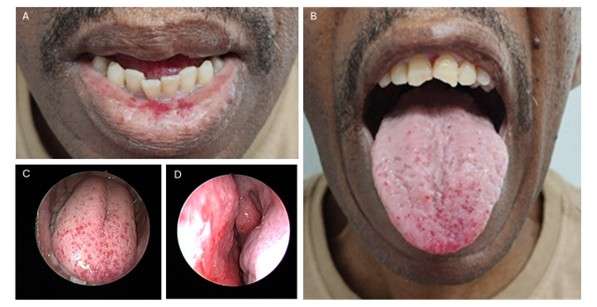
Figure 1. Telangiectasia at characteristic sites in hereditary hemorrhagic telangiectasia (HHT). Telangiectasia of the (A) lips, (B-C) tongue, and (C) nasal mucosa in one of the South African patients with HHT in this study. These features may be masked if a facemask is worn during a respiratory pandemic like the COVID-19 pandemic.
Copyright: Stephanie Kennedy. Informed consent was obtained from the patient.
HHT in Africa
Until recently, data on HHT in Africans were limited to case reports [3-9]. The first comprehensive report of 16 South Africans with HHT only appeared in 2021 [10]. By describing the effect of the COVID-19 pandemic on patients with HHT in central South Africa, I have also contributed to the limited literature from Africa [11].
About the study
My colleagues and I wanted to see how the COVID-19 pandemic affected nosebleeds and anaemia in patients with HHT in central South Africa. In an observational study, we compared epistaxis severity scores (ESSs) and haemoglobin (Hb) levels before and after the pandemic started. The ESS calculates nosebleed severity in HHT. The patient gets a score between 0-10. When it changes by ≥0.71, it is considered clinically significant [12]. Hb is a laboratory measurement that tells us whether a patient has enough oxygen-carrying red blood cells. If the Hb is too low, a patient has anaemia. More severe nosebleeds may cause the Hb may drop. When nosebleeds are less, it may rise again. We also looked at factors that could influence nosebleed severity and anaemia: (i) facemask use, (ii) nasal versus oral swabs to test for SARS-CoV-2, (iii) COVID-19 disease and (iv) its management, (v) COVID-19 vaccines, and (vi) the social impact of the pandemic.
Our sample size was small (n=24), but notable for a rare disease. We had enough data to compare ESSs and Hb levels before and after the pandemic started in 11 and 15 patients. The change in ESS was clinically significant in 6/11 (54.6%) patients. The change in Hb was clinically in significant in 12/15 (80%) patients. We identified clinical and social factors that affected nosebleed severity and anaemia: Nasal swab testing for SARS-CoV-2 caused nosebleeds in nine patients. One patient required nasal packing with BIPP to stop such a nosebleed. This occurred despite her requests for an oral swab, which were probably declined due to a lack of awareness about HHT amongst healthcare workers. Stress, missed appointments, and lockdown restrictions worsened nosebleeds in some patients. COVID-19 vaccines did not. Wearing a facemask in public was a legal requirement in South Africa during the pandemic. Some patients complained that facemasks worsened their nosebleeds. A child was even sent home from school when his nosebleed soaked his mask, which left him feeling further marginalized by his rare disease. We could not show a correlation between facemasks and nosebleed severity, concluding that these may be subjective perceptions based on blood-soaked masks. However, considering that facemasks could alter airflow in the nostrils and dry out the nasal mucosa, causing fragile telangiectasia to bleed, we suggested even more frequent nasal moisturisation when wearing a facemask.
Only 2/24 (8.3%) HHT patients had confirmed COVID-19 disease. One had a mild upper respiratory tract infection. The second was hospitalized with pneumonia. Despite multiple comorbidities (HIV and an empyema following previous tuberculosis with lung and heart failure) this patient had a favourable outcome. He required facemask oxygen and was discharged after ten days. For me, this patient personified the pandemic’s impact on HHT in South Africa: He survived COVID-19 against all odds but lost several close relatives to the virus. In the early stages of the pandemic, he missed appointments due to fears of infection. He was unemployed and relied on public transport or ambulance to travel 333 km for specialist care of his HHT. By the third wave, lockdown restrictions prevented him from accessing transport to the clinic. He was eventually able to attend the clinic to receive bimonthly iron infusions. We were hoping to raise his Hb from 5-8 g/dL so that his fitness for surgery of his empyema could be re-evaluated. But getting a chest CT was even more challenging than before the pandemic. Unfortunately, he succumbed to his chronic conditions before he could ever go for the surgery.
What this study adds
Recommendations to minimise nosebleeds and anaemia in HHT during a respiratory pandemic like COVID-19:
- Consider risks versus benefits of facemasks.
- Frequent nasal moisturisation may reduce dry mucous membranes when wearing masks.
- Avoid unnecessary nasal manipulation to adjust masks.
- A visor may be better than no mask when patients cannot tolerate facemasks.
- Perform oral, not nasal swabs to test for SARS-CoV in HHT.
- Carry a card with information about HHT. Healthcare workers may be unaware of the complications of this rare disease.
- Follow the same recommendations for COVID-19 vaccination as the general public.
- Emotional support is essential during a pandemic. Stress may precipitate nosebleeds in some patients.
In a rare disease, the individual matters
The COVID-19 pandemic may be over, but its aftermath is still felt. It had a global impact, but it also had individual impacts. The patient that we lost during the pandemic, not from COVID-19 disease, but because of delays in caring for his chronic conditions, matters. The child whose teacher sent him home because of his blood-soaked mask, matters. The woman whose nose had to be packed with BIPP after a nasal swab, matters.
References
- Pahl K, Kasthuri RS. Hereditary Hemorrhagic Telangiectasia. In: Craig S. Kitchens CMK, Barbara A. Konkle, Michael B. Streiff, David A. Garcia, ed. Consultative Hemostasis and Thrombosis, 4th ed. Philadelphia: Elsevier, 2019,190–206.
- Faughnan, M. E. et al. Second International Guidelines for the Diagnosis and Management of Hereditary Hemorrhagic Telangiectasia. Ann. Intern. Med. 173, 989–1001 (2020).
- Theron, A. M. Hereditary haemorrhagic telangiectasia; report of a Bantu case. South Afr. Med. J. Suid-Afr. Tydskr. Vir Geneeskd. 27, 557–559 (1953).
- Kennedy, I. Hereditary telangiectasia in a Zulu family. South Afr. Med. J. Suid-Afr. Tydskr. Vir Geneeskd. 38, 917 (1964).
- Jaiyesimi, A. E. & Mba, E. C. Hereditary haemorrhagic telangiectasia in Nigeria: case report. Cent. Afr. J. Med. 35, 363–365 (1989).
- Kitonyi, G. W., Wambugu, P. M., Oburra, H. O. & Ireri, J. M. Hereditary haemorrhagic telangiectasia in a black adult male: case report. East Afr. Med. J. 85, 412–416 (2008).
- Westermann, C. J. J., Kitonyi, G. W. & Letteboer, T. G. W. Is hereditary haemorrhagic telangiectasia rare in the black race? The first sub-Saharan mutation. Haemoph. Off. J. World Fed. Hemoph. 17, e244 (2011).
- Canzonieri, C. et al. Hereditary haemorrhagic telangiectasia in North African and sub-Saharan patients. South Afr. Med. J. Suid-Afr. Tydskr. Vir Geneeskd. 104, 256–257 (2014).
- Kiyeng, J. C., Siika, A., Koech, C. & Bloomfield, G. S. Definite hereditary hemorrhagic telangiectasia in a 60-year-old black Kenyan woman: a case report. J. Med. Case Reports 10, 126 (2016).
- Mutize, T. T. et al. The clinical and genetic features of hereditary haemorrhagic telangiectasia (HHT) in central South Africa-three novel pathogenic variants. Mol. Biol. Rep. 47, 9967–9972 (2020).
- Kennedy, S. J., Haupt, L. & Seedat, R. Y. The effect of the COVID-19 pandemic on epistaxis and anaemia in patients with hereditary haemorrhagic telangiectasia (HHT) in central South Africa. Orphanet J. Rare Dis. 20, 364 (2025).
- Yin, L. X. et al. The minimal important difference of the epistaxis severity score in hereditary hemorrhagic telangiectasia. The Laryngoscope 126, 1029–1032 (2016).
