
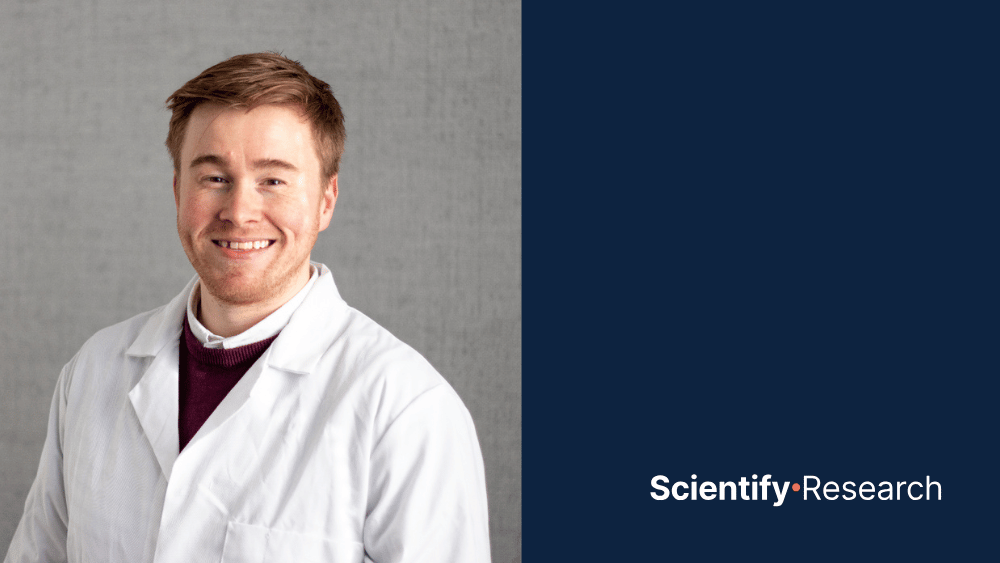
Preface: How can early-career researchers turn promising scientific discoveries into new approaches that make a difference? In this interview, we speak to Dr. Ian Harrison, recipient of the 2025 David Hague Early Career Investigator of the Year Award, about his research journey in neuroscience, the challenges of building an independent research group, and the role of funding and collaboration in advancing scientific discovery.
Could you tell us about your research into the glymphatic system and its role in neurodegenerative diseases, particularly your work on aquaporin-4 and the clearance of disease-associated proteins from the brain? What motivated you to pursue this area of research?
My group studies the glymphatic system, a network involved in the movement of fluid through the brain and the clearance of waste products, including proteins associated with neurodegenerative diseases. One of our main research focuses is aquaporin-4, a water channel found predominantly on astrocytes, specialized support cells that surround blood vessels in the brain. Aquaporin-4 plays an important role in glymphatic function, and we want to understand how disease processes in conditions such as Alzheimer’s and Parkinson’s affect this channel, potentially disrupting the clearance of disease-associated proteins.
A key question in our laboratory is how the glymphatic system contributes to the clearance of proteins such as tau and alpha-synuclein, which are implicated in different neurodegenerative diseases. In research supported by my first independent grants, we found that pharmacologically inhibiting aquaporin-4 could alter glymphatic function. In disease models, this was associated with increased aggregation of tau and alpha-synuclein, as well as poorer performance in behavioral tasks. We are now investigating the mechanisms underlying these effects and, importantly, whether enhancing glymphatic function could help protect against disease-related changes.
My motivation for researching dementia is personal. When I was a teenager, two of my grandparents developed dementia: my paternal grandfather had Alzheimer’s disease, and my maternal grandmother had Lewy body dementia. I remember my parents explaining that there were no medicines that could make them better and that their conditions would progressively worsen. I found this difficult to understand, particularly when treatments were available for so many other medical conditions.
That experience stayed with me. I went on to study pharmacology before pursuing further training in neuroscience and neurodegenerative disease research. I wanted to understand why these diseases develop and, ultimately, whether we could find better ways to treat them. That motivation continues to drive my work today: to improve our understanding of the brain and translate those insights into new approaches that could make a meaningful difference to people living with dementia and their families.
What attracted you to the David Hague Early Career Investigator of the Year Award, and what did receiving this recognition mean to you at this stage of your research career?
The award recognizes outstanding early-career contributions to biomedical dementia research, so it felt closely aligned with my work and my ambition to address important questions in dementia research while exploring ideas that could open up new avenues of investigation.
At this stage of my career, I’m building and expanding my independent research program. Recognition from the dementia research community is hugely encouraging, but the award is also valuable in practical terms. Its flexible support gives us the freedom to pursue experiments that fall outside the scope of my existing fellowship funding. Research doesn’t always follow a straight path, and sometimes the most interesting discoveries come from following an unexpected lead. I like to think of this funding as giving us the freedom to pursue a few scientific “side quests”, exploring promising ideas that might not fit neatly into an existing grant but could lead somewhere exciting.
For me, the award is both an endorsement of the work we’ve done so far and an opportunity to explore new directions in understanding the role of the glymphatic system in neurodegenerative disease.
What was your experience of preparing your application for the David Hague Early Career Investigator of the Year Award like, and how did you communicate the significance and potential impact of your research?
I found putting the application together genuinely challenging. As scientists, we spend so much time thinking about the detail of our work that stepping back and explaining the bigger picture in a clear, concise way can be surprisingly difficult. I certainly didn’t manage that perfectly on the first draft! It took a lot of work to refine the story, decide what to emphasize and polish the wording until I felt it communicated both the science and why it mattered.
For me, the key was to connect the question we were asking, the evidence we had, and what we wanted to investigate next. Our findings linking disruption of glymphatic function with increased tau aggregation and poorer memory in a disease model for example, gave us a rationale for exploring whether enhancing the system might have beneficial effects. At the same time, it was important to be clear about what the data actually showed, rather than getting carried away with what we hoped they might eventually lead to. There’s a fine line between communicating the potential impact of your research and accidentally making it sound as though you’ve already solved the problem!
My main advice from the experience would be to give yourself plenty of time to redraft and get feedback from people who can offer a fresh perspective. I also think it’s worth remembering that this is an early-career award: you’re not expected to have solved all the world’s problems already! What matters is showing that you have the ambition to make a meaningful difference in your area of research, a clear vision of what you want to achieve, and a convincing rationale for why the work matters. I found the application became much stronger when I stopped trying to demonstrate the impact of everything we’d already done and focused instead on explaining the important questions we’re trying to answer and where they might lead.
Based on your experience, what best practices would you recommend to early-career researchers preparing an application for a competitive research award such as the David Hague Early Career Investigator of the Year Award?
I think one of the most useful things you can do is make it as easy as possible for the panel to understand your work and what you bring to the field. You know your own research inside out, so it’s easy to assume that the significance of a particular finding or research question is obvious to everyone else. Getting someone outside your immediate area to read your application can be a real eye-opener. If they can’t easily explain back to you what you’re trying to achieve and why it matters, you may need to rethink how you’ve told the story.
I’d also encourage people to be clear about their own contribution. Research is almost always a team effort, and it’s important to acknowledge the people who have helped you along the way. At the same time, don’t be afraid to explain which ideas you’ve developed, what you’ve contributed, and where you want to take your work next. Particularly for an early-career award, the panel wants to get a sense of you as a researcher and research leader, not just the projects you’ve been involved in.
It’s tempting to try to squeeze every achievement and finding into an application, especially when you’ve put so much work into them. I think it’s often more effective to be selective and focus on the examples that best demonstrate your contribution and potential. You should be honest about what you’ve shown so far and what remains to be done, too. You don’t need to have all the answers; you need to show that you can ask worthwhile questions, think critically about the evidence, and develop a credible plan for taking your work forward.
Finally, don’t underestimate how much work goes into getting an application right, and don’t be disheartened if the first draft isn’t very good! As an early-career PI, my schedule is often pretty full-on, and I know from experience that trying to write something thoughtful and persuasive when my head is already full of a dozen other things rarely works very well. I had to make a conscious decision to step away from my usual workload and give the application some proper, uninterrupted attention. It was time well spent. When you’re caught up in the day-to-day demands of running a research group, it can be difficult to step back and take stock of what you’ve achieved and where you want to go next. Setting aside that time helped me reflect on my progress so far, my contribution to the field, and what I hope to achieve in the coming years. My advice would be to treat the application as a piece of work that deserves dedicated time, rather than something you have to squeeze into the gaps between everything else.
What did it feel like to learn that you had been selected as the 2025 David Hague Early Career Investigator of the Year?
I found out as I was leaving work to pick up my kids, so it was quite a moment, as I was already running late for the school run! The first thing I did was send a screenshot of the email to our lab WhatsApp group, with nothing but a shocked-face emoji. I think that probably sums up my initial reaction pretty well: I was absolutely delighted, but also a little stunned!
I was particularly pleased to be able to share the news with the group, because research is very much a team effort. Awards are often presented to one individual, but the work behind them is rarely the achievement of just one person. I feel very fortunate to work with such a talented and dedicated team, and I see this award as recognition of their hard work as much as anything I’ve done myself.
It’s a real boost to have work you’ve spent years developing recognized in this way, particularly when research inevitably involves technical challenges, setbacks and plenty of uncertainty along the way. You spend so much time focused on what still needs to be done that it’s rewarding to have a moment to appreciate how far you’ve come. I was also excited about what the award might allow us to do next. It was a lovely opportunity to celebrate what we’d achieved together, while looking ahead to the next stage of the research.
Were there any particular challenges or setbacks you encountered while developing your research program or establishing your independent research group?
The science itself is challenging. Imaging the glymphatic system is technically difficult, and when we began this work, there was always the possibility that the biology wouldn’t behave as we hypothesized. That uncertainty is part of our research more broadly: we are working in a field where many fundamental questions remain unanswered, and even when experiments work technically, the results don’t always fit our expectations. It means that progress often requires persistence, careful interpretation and a willingness to rethink our hypotheses and approaches.
There have also been challenges associated with working in a field as actively debated as glymphatic research. There is still considerable discussion about how the system works and the biophysics underpinning it. That debate is an important part of how science progresses, but it can mean that manuscripts and grant applications face lengthy review processes. I found this particularly challenging when publishing some of my first papers as a senior author. You’re not only presenting your findings; you’re also beginning to establish your own scientific reputation and research direction, which makes those early experiences feel particularly significant.
Establishing an independent research group brought a different set of challenges, and my timing was perhaps not ideal! I set up my lab just three months before the COVID lockdowns began. My first postdoc had only been in the role for two weeks when lockdown started, and a few months later I had to furlough him. That was a particularly difficult way to begin building a team and getting a research program off the ground.
We were still at the very beginning of the work, setting up experiments and trying to generate our first data. Some established groups were able to use the enforced time away from the lab to analyze existing data and write up ongoing projects. We simply didn’t have that luxury. When we were eventually able to return to the lab, I felt enormous pressure to make up for lost time. I worked incredibly hard, probably harder than was sustainable, because I felt a very personal responsibility to deliver on the funding I had been awarded.
Those first grants were from charities, and that responsibility weighed heavily on me. You know that the money comes from people who have organized marathons, held cake sales and raised funds because they want to make a difference to people affected by these diseases. I really didn’t want to let them down. As these were my first grants as a PI, I felt that responsibility particularly acutely, and at times I pushed myself close to burnout trying to get the research moving forward.
Despite those challenges, it has been rewarding to see the research program develop and the team grow. It certainly wasn’t the start I had envisaged, but it gave me a much clearer understanding of what it takes to build a research group, beyond simply having a good scientific idea.
How did you approach or overcome those challenges, and is there anything from that experience that you would share with other early-career researchers?
I learned to stay focused on the scientific question while being flexible about the route to answering it. With technically demanding work, methods often need to be refined and results may challenge your initial assumptions. It’s important to treat that as part of the process rather than expecting every experiment to work first time. Sometimes you need to take a step back, work out what the data are really telling you, and rethink your approach. That’s particularly important in a field like glymphatic research, where there are still fundamental questions to resolve and it’s important to be rigorous about what the evidence does and doesn’t show.
The support of funders and collaborators was also crucial. Fellowships from Alzheimer’s Research UK and Parkinson’s UK gave me the opportunity to develop an independent program and pursue an idea that was high-risk and technically challenging. Collaborators brought complementary expertise and were willing to explore the question with me. Having people you can turn to for advice, who challenge your thinking and help you work through difficult problems, makes a huge difference when you’re establishing yourself as an independent researcher.
On a personal level, one of the biggest lessons was that you can’t make up for lost time indefinitely by simply working harder. I felt a strong responsibility to deliver on the funding I’d been awarded, and that sometimes led me to push myself too hard. I still believe it’s important to take that responsibility seriously, but I’ve come to appreciate that research is a long-term commitment. Looking after yourself and creating a supportive environment for the people you work with aren’t luxuries; they’re essential to doing good science over the long term.
For other early-career researchers, I’d say: find a question you genuinely care about, seek out people whose skills complement your own, and don’t assume that a difficult start means an idea isn’t worth pursuing. Be persistent, but don’t confuse persistence with sticking rigidly to your original plan, or with pushing yourself to the point of exhaustion. Research is demanding and setbacks are inevitable, so give yourself and your team room to learn, adapt and recover together along the way.
How do you hope the recognition and flexible research support provided through the David Hague Award will influence the next stage of your research and your development as a research leader?
I’m currently supported by an Alzheimer’s Society Dementia Research Leader Fellowship, which is helping me develop my independent research program. The David Hague Award provides something different: flexible funding that allows us to pursue additional experiments beyond the scope of my fellowship. Research grants are understandably built around defined plans, but new questions often emerge as results come in. This award gives us the opportunity to act on those findings, explore promising ideas and test approaches that we might otherwise struggle to fund through our existing grants.
The recognition is also a real encouragement as I continue to establish my group and define its research direction. We’re now investigating the role of the glymphatic system across different disease settings, including testing compounds in additional models of Alzheimer’s disease that better reflect the complex protein changes seen in patients.
We want to establish whether our findings hold up in these models and, if the results are encouraging, strengthen the case for future clinical development. We’re also beginning to work with industry to explore how the glymphatic system might be harnessed as a drug delivery route to help treatments reach the brain more effectively. These are still developing areas of research, and any clinical application will depend on further evidence, but they offer exciting possibilities. Building these collaborations and learning how to move discoveries towards potential therapeutic applications is an important part of my development as a research leader.
Ultimately, I want to build a collaborative, ambitious research program that connects fundamental discoveries with new approaches that could benefit people affected by dementia.
What contribution do you hope your research into the glymphatic system and aquaporin-4 will make to our understanding of neurodegenerative diseases and, ultimately, to the development of new approaches for people living with dementia?
I hope our work helps answer a fundamental but important question: can we harness the brain’s own clearance systems to influence the build-up of proteins associated with neurodegenerative diseases?
Our research has shown in experimental models that disrupting glymphatic function can influence the aggregation of proteins such as tau and alpha-synuclein, as well as performance in behavioral tasks. We now want to understand the underlying mechanisms more precisely and establish whether enhancing glymphatic function could have beneficial effects across different disease models. Aquaporin-4 is a key focus because of its role in regulating water movement in the brain, but we need to establish how best to target this pathway and whether the effects we observe in experimental models are relevant to human disease.
Looking further ahead, I’m excited by the possibility that the glymphatic system could offer opportunities not only to influence the clearance of disease-associated proteins, but also to help deliver treatments to the brain. We’re beginning to explore these possibilities with industry, although both remain areas of active investigation rather than established clinical approaches. If we can build a strong evidence base, glymphatic-targeted strategies could potentially complement existing and future treatments for neurodegenerative diseases.
Ultimately, I hope our research helps establish whether the glymphatic system represents a viable therapeutic target and provides the knowledge needed to translate that understanding into new approaches for people living with dementia. There’s still a long way to go, but I’d like our work to help bridge the gap between understanding how the brain works and developing treatments that make a meaningful difference to patients and their families.
Looking ahead to the next 5–10 years, where would you like to see research, innovation, and funding in dementia and neurodegenerative disease research develop?
Over the next 5–10 years, I’d like to see sustained investment in both fundamental discovery and the often difficult process of translating promising findings into new treatments. Dementia is complex, and there’s unlikely to be a single mechanism or treatment that provides the answer for everyone. We need to understand the different biological processes involved and be willing to explore a range of therapeutic approaches, including ideas that challenge existing thinking.
For emerging areas such as glymphatic research, long-term support is particularly important. We still need to establish how the system functions across different diseases, how reliably we can measure it, and whether it can be safely and effectively targeted in people. These are fundamental questions, and answering them takes time. I’d like to see funding that recognizes the value of building a robust evidence base, rather than expecting early-stage research to demonstrate an immediate route to clinical impact.
I’d also like to see more funding opportunities that give early-career researchers the independence and flexibility to develop their own ideas. Fellowships can provide the foundation for an independent research program, while smaller, flexible awards can make it possible to follow up unexpected findings or test a promising idea that falls outside an existing grant. Having experienced how valuable that flexibility can be myself, I think it’s important that researchers have room to take considered risks and explore new directions, even when the outcome isn’t guaranteed.
Finally, I hope we’ll see stronger links between fundamental neuroscience, imaging, drug discovery, industry and clinical research. Collaboration across these areas will be essential if we’re to turn a better understanding of dementia into treatments that genuinely benefit patients. Over the next decade, I’d like to see us become better at identifying promising discoveries, testing them rigorously and moving the strongest candidates towards clinical trials.
My own ambition is to help establish whether the glymphatic system offers new opportunities for treating neurodegenerative diseases, while contributing to a research environment that gives other scientists the support and freedom to pursue ideas that could make a real difference.
Find funding for your next research project
Whether you’re exploring new research directions, developing your work or looking to take the next step in your career, finding relevant funding opportunities is essential. ScientifyResearch brings research funding opportunities together in one searchable database, making it easier to discover grants that match your research interests and goals.
Click here to find your next funding opportunity in our database.
Acknowledgements
We sincerely thank Dr. Ian Harrison for sharing his insights into glymphatic system research, neurodegenerative diseases and his experience as an early-career researcher. We appreciate his openness about the challenges of building an independent research program and the importance of funding, collaboration and continued investment in dementia research.